😔 At the request of the track's copyright holder, the price is $3
Hi, I am Rita. I transcribe piano sheets for popular music. All my sheet music are accurate but simple, beginner-level transcriptions with lyrics (singing is good for health) and harmonic chords.
I consider reasonable requests.
Sometimes I post free PDFs. Follow me!
More Melanie Martinez
More Pop
“Tunnel Vision Sheet Music”
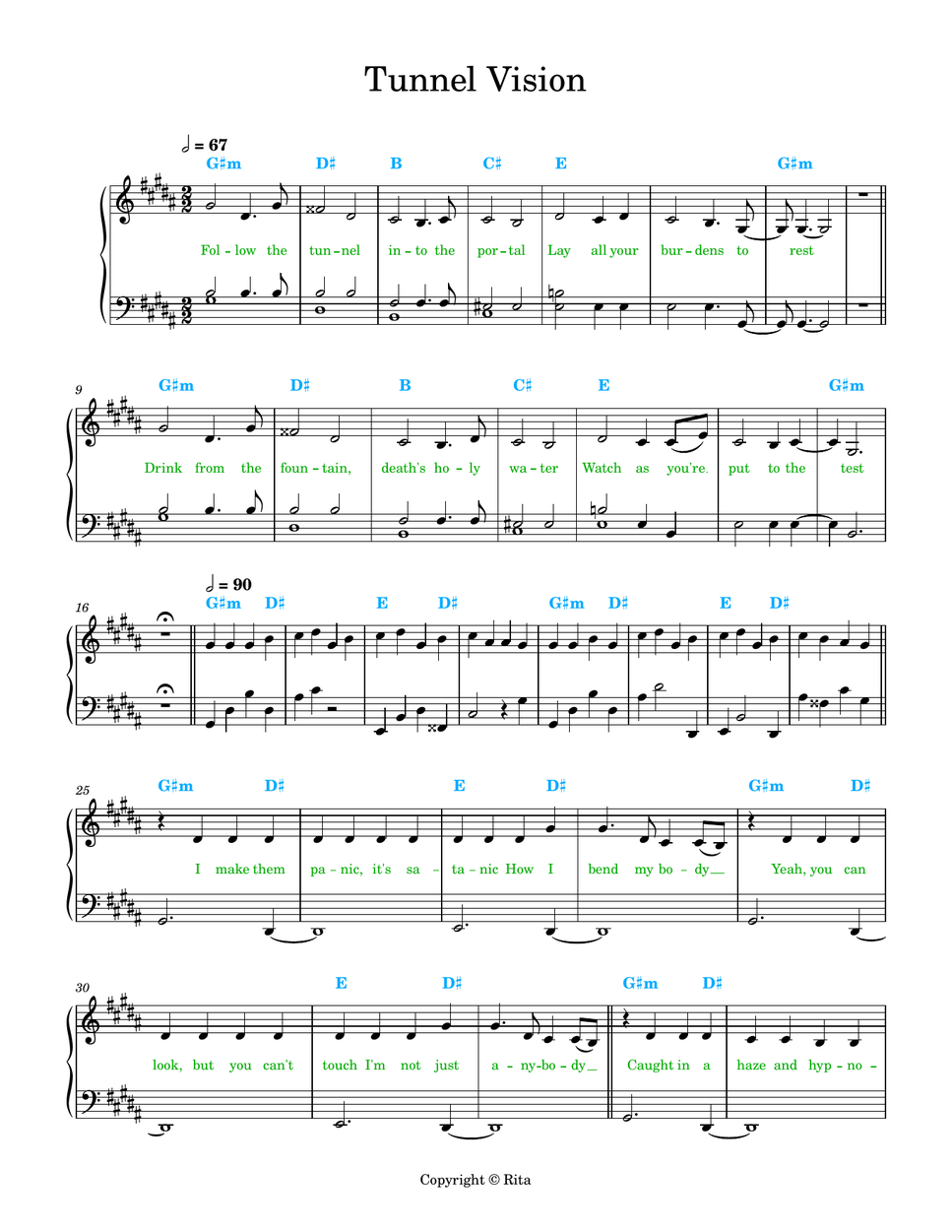
I doubled note values to make sightreading easier for beginners. The track isn't recorded in the 2/2 time.
"Tunnel Vision" is played with a straight rhythm in common time. The outro switches to the 6/8 time. Nevertheless, it is easy to count for beginners; accent strong beats to maintain a steady pulse. Practice "Tunnel Vision" slowly along with the recording.
Imitate the vocal delivery by Melanie Martinez or it won't sound as the song. The vocal part is rhythmic but with pitch inflections (slurred notes). All inflected notes should be played very quietly. A predominant vocal style is staccato.
Notice the double sharp 𝄪 F, it means the F was raised twice so you play the white G key. The symbol fermata (𝄐) means longer pauses.
To keep listeners attention, the *chorus* was made to be the biggest part of the song. Play every part differently, as expressively as possible. If some notes are too difficult to play, omit them focusing on emotions instead of sightreading.
"Tunnel Vision" has a polyphonic arrengement: the instrumental part provides not only a harmony to support the vocal but also its own melody. You can play the riff from the bars 17-24 if you need a duo for piano and voice.
"Tunnel Vision" is originally composed in A-flat minor with seven flats but I transcribed it in its enharmonic *key,* G Sharp Minor with only five Sharps, and uses basic major and minor chords G♯m D♯ B C♯ E but the underlying harmony lacks motion and is fundamentally static: there is no sense of harmonic progression. Its only use is to break monotony.
The aesthetic value of a melodic line is achieved through the use of unconventional tonal behavior: dissonant tones F𝄪 and E♯ and their respective non-harmonic chords D♯ and C♯ add tension